The modern healthcare ecosystem depends heavily on uninterrupted utility infrastructure, and among its most critical components is the Medical Gas System. These systems supply life-supporting gases such as oxygen, medical air, and vacuum services to operating rooms, ICUs, and emergency departments. Even a minor failure can directly impact patient safety and clinical outcomes.
In recent years, artificial intelligence (AI) has emerged as a transformative force in healthcare infrastructure management. Its application in predictive maintenance is redefining how Medical Gas Pipeline Systems (MGPS) are monitored, maintained, and optimized. Companies like Ziebaq are increasingly aligning with this technological shift to enhance system reliability, safety, and operational efficiency.
1. Introduction: Importance of Medical Gas System in Healthcare Infrastructure
A Medical Gas System is one of the most critical lifeline infrastructures in any healthcare facility, responsible for the continuous and controlled supply of medical gases such as oxygen, nitrous oxide, medical air, carbon dioxide, and vacuum services. These gases are essential for life-support systems, surgical procedures, anesthesia delivery, intensive care units, and emergency response operations. Any interruption in a Medical Gas Pipeline System (MGPS) can have immediate and severe consequences on patient safety, making reliability a non-negotiable requirement.
Hospitals today are increasingly complex ecosystems where multiple systems must operate in perfect synchronization. Within this environment, the Medical Gas System functions as a silent backbone, ensuring uninterrupted clinical operations. Traditionally, maintenance of these systems was reactive or schedule-based, often leading to unexpected failures or inefficient servicing cycles.
With the rise of digital healthcare infrastructure, organizations such as Ziebaq are focusing on enhancing the intelligence, reliability, and monitoring capabilities of Medical Gas Systems. The goal is not just to maintain performance but to anticipate failures before they occur. This shift is especially important in high-dependency zones like ICUs, operation theatres, neonatal units, and emergency departments where even a brief gas supply disruption can be critical.
Modern healthcare demands systems that are not only robust but also intelligent. This is where predictive maintenance powered by artificial intelligence is transforming the way a Medical Gas System is designed, monitored, and maintained. It introduces a proactive approach that improves system uptime, enhances safety compliance, and optimizes operational efficiency across hospital infrastructure.
2. Predictive Maintenance in Medical Gas Pipeline System (MGPS)
Predictive maintenance in a Medical Gas System refers to the use of advanced monitoring techniques, data analytics, and sensor-driven insights to predict potential equipment failures before they occur. Unlike traditional maintenance models—preventive (time-based) or reactive (failure-based)—predictive maintenance focuses on real-time system health evaluation.
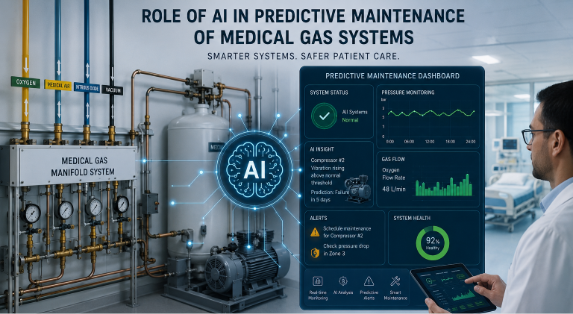
In a Medical Gas Pipeline System (MGPS), multiple components such as compressors, vacuum pumps, pressure regulators, alarm systems, and pipeline networks continuously operate under strict performance parameters. Predictive maintenance leverages continuous data collection from these components to identify early warning signs of malfunction. For example, a slight deviation in oxygen pipeline pressure or irregular compressor vibration can indicate an upcoming failure.
This approach significantly reduces uncertainty in system management. Instead of waiting for breakdowns or performing unnecessary maintenance checks, hospitals can act precisely when required. This improves both operational efficiency and safety standards.
Companies like Ziebaq are increasingly integrating predictive maintenance principles into Medical Gas System design and servicing frameworks. By combining engineering expertise with smart monitoring systems, Ziebaq enables healthcare facilities to transition toward intelligent infrastructure management.
Predictive maintenance also plays a crucial role in ensuring regulatory compliance. Medical facilities must adhere to strict safety guidelines for MGPS operations. Continuous monitoring and automated reporting help maintain accurate maintenance records, reducing compliance risks.
Ultimately, predictive maintenance transforms the Medical Gas System from a static utility network into a dynamic, self-monitoring infrastructure capable of anticipating issues, minimizing downtime, and ensuring uninterrupted patient care.
3. AI Technologies Transforming Medical Gas System Operations
Artificial intelligence is the core enabler of predictive maintenance in a Medical Gas System, bringing automation, intelligence, and precision to infrastructure monitoring. AI systems rely on machine learning algorithms, IoT-enabled sensors, and data analytics platforms to continuously evaluate system performance in real time.
In a Medical Gas Pipeline System, AI collects data from pressure sensors, flow meters, compressor units, and alarm panels. This data is processed using machine learning models trained on historical failure patterns. These models identify deviations from normal operating behavior and detect anomalies that may indicate potential system failure.
One of the most powerful applications of AI is anomaly detection. For example, if oxygen flow in a specific hospital wing fluctuates abnormally, the AI system immediately flags it as a potential leak or blockage. Similarly, vibration analysis in compressors helps detect mechanical wear long before physical breakdown occurs.
Another key technology is predictive modeling. AI systems analyze long-term operational trends to forecast when components are likely to fail. This enables maintenance teams to schedule repairs proactively, reducing disruption to hospital operations.
Natural language processing and intelligent dashboards also play a role by converting complex system data into actionable insights for engineers and hospital administrators.
Organizations like Ziebaq are increasingly leveraging AI-driven frameworks to enhance the reliability of Medical Gas Systems. By integrating smart diagnostics and automated alert systems, Ziebaq helps healthcare facilities move toward intelligent infrastructure ecosystems.
AI also supports energy optimization by balancing load distribution across gas supply units, ensuring efficiency without compromising safety. This makes the Medical Gas System not only smarter but also more sustainable in the long term.
4. Key Benefits of AI-Based Predictive Maintenance in Medical Gas Systems
The integration of artificial intelligence into a Medical Gas System delivers transformative benefits across safety, efficiency, and cost management. One of the most significant advantages is enhanced patient safety. Since Medical Gas Pipeline Systems directly support critical care environments, any interruption can be life-threatening. Predictive maintenance ensures continuous monitoring and early detection of issues, significantly reducing the risk of unexpected system failure.
Another major benefit is reduced operational downtime. Traditional maintenance often requires shutting down parts of the system for inspection or repair. With AI-driven predictive maintenance, interventions are scheduled only when necessary, minimizing disruptions to hospital operations.
Cost efficiency is also a key outcome. By identifying issues early, hospitals avoid expensive emergency repairs and reduce unnecessary maintenance activities. Equipment lifespan is extended as components are serviced at optimal intervals rather than on rigid schedules.
For large healthcare facilities, regulatory compliance is a critical concern. A Medical Gas Pipeline System must adhere to strict safety standards and documentation requirements. AI systems automatically generate maintenance logs and compliance reports, reducing administrative burden and improving audit readiness.
Energy efficiency is another important advantage. AI optimizes compressor usage and gas distribution, ensuring that resources are not wasted. This leads to lower operational costs and improved sustainability.
Companies like Ziebaq contribute to these benefits by implementing smart engineering solutions that align with predictive maintenance principles. Their approach enhances system reliability while supporting hospitals in adopting modern, technology-driven infrastructure management.
Overall, AI transforms the Medical Gas System into a highly reliable, efficient, and intelligent utility framework that supports uninterrupted healthcare delivery.
5. Applications, Challenges, and Future of AI in Medical Gas Systems
The application of AI in a Medical Gas System spans multiple critical areas of hospital infrastructure. In operating theatres and ICUs, AI ensures uninterrupted oxygen and anesthesia gas supply by continuously monitoring pipeline pressure and flow stability. In emergency departments, it helps detect sudden fluctuations that may indicate leaks or system stress.
In compressor and vacuum systems, AI analyzes mechanical performance to predict wear and prevent unexpected breakdowns. Alarm systems are also optimized using AI, which reduces false alerts and ensures that only meaningful warnings are escalated.
Despite its advantages, adoption of AI in a Medical Gas Pipeline System comes with challenges. High initial investment in sensors, integration complexity with legacy systems, and the need for specialized technical expertise can slow implementation. Data security is also a major concern, as hospital infrastructure systems must be protected from cyber threats.
However, the future of Medical Gas Systems is rapidly evolving toward full automation. Concepts such as digital twins of hospital utility systems, self-healing pipeline networks, and centralized AI control centers are already emerging.
Organizations like Ziebaq are at the forefront of this transformation, developing smarter infrastructure solutions that integrate AI-driven predictive maintenance with advanced engineering design. This ensures that hospitals are not only equipped with reliable systems today but are also prepared for the future of intelligent healthcare infrastructure.
Ultimately, AI will redefine the Medical Gas System as a self-regulating, predictive, and adaptive ecosystem that ensures maximum safety, efficiency, and reliability in healthcare environments.