Planning a large-scale laboratory project requires careful coordination, thoughtful budgeting, and the right equipment. Whether you are setting up a pharmaceutical laboratory, a university research centre, a healthcare testing facility, or an industrial laboratory, choosing the right furniture supplier is an important decision that can affect your project’s quality, timeline, and long-term performance.
Laboratory furniture is more than tables, cabinets, and workbenches. It must support daily operations, withstand the conditions of the working environment, and help maintain a safe and organized workspace. When you are purchasing furniture for an entire facility, even a small mistake in material selection, measurements, or installation planning can lead to delays and additional expenses.
This is why evaluating laboratory furniture suppliers carefully is essential before making a purchasing decision.
A reliable supplier should offer more than competitive prices. You need a partner who understands your project requirements, provides suitable furniture solutions, maintains consistent quality, and delivers products according to the agreed schedule.
In this guide, we will explore the key factors to consider when evaluating laboratory furniture suppliers for large-scale projects and how to make a decision that supports your facility’s long-term needs.
1. Understand Your Project Requirements Before Approaching Suppliers
Before contacting laboratory furniture manufacturers or suppliers, take time to understand what your project actually requires.
Large-scale laboratory projects often involve multiple work areas, storage systems, specialized workstations, and different furniture configurations. Without a clear plan, it becomes difficult to compare quotations or determine whether a supplier can meet your expectations.
Start by identifying the type of laboratory you are developing and the activities that will take place inside it.
For example:
- Pharmaceutical laboratories may require chemical-resistant worktops, specialized storage, and furniture suitable for their specific testing procedures.
- Educational laboratories may need durable workbenches, storage cabinets, and workstations designed for students and instructors.
- Research laboratories may require flexible layouts that accommodate changing experiments and equipment.
- Medical testing laboratories may need furniture that supports efficient workflows, cleaning procedures, and the requirements of their particular testing environment.
- Industrial laboratories may require robust furniture designed for frequent use and exposure to specific chemicals or environmental conditions.
Prepare a list of furniture items, approximate quantities, room dimensions, installation requirements, and any relevant technical specifications.
Having this information ready will help laboratory furniture suppliers understand your expectations and provide more accurate quotations.
2. Evaluate the Supplier’s Experience With Large-Scale Projects
Experience matters when purchasing laboratory furniture for an entire facility.
Supplying a few workbenches is different from coordinating furniture for multiple laboratories, departments, or buildings. Large-scale projects require effective planning, consistent product quality, inventory management, and coordination between manufacturing, transportation, and installation teams.
When evaluating potential laboratory furniture suppliers, ask about their experience with projects similar to yours.
Consider the following questions:
- Have they supplied furniture for laboratories of a comparable size?
- Have they worked with institutions or industries similar to yours?
- Can they manage large orders without compromising quality?
- Do they have a structured process for handling project requirements?
- Can they coordinate deliveries and installations across multiple areas?
Ask for relevant project references, case studies, or photographs of completed installations where available.
You should also discuss any challenges the supplier has encountered during previous projects and how those challenges were resolved.
An experienced laboratory furniture supplier should be able to explain its project approach clearly and demonstrate how it can manage the practical requirements of your facility.
3. Check the Quality of Materials and Construction
The quality of laboratory furniture directly affects its durability, usability, and maintenance requirements.
Unlike ordinary office furniture, laboratory furniture may be exposed to chemicals, moisture, heat, heavy equipment, frequent cleaning, or demanding working conditions. The appropriate materials depend on the laboratory’s intended use.
For this reason, do not evaluate laboratory furniture suppliers based on appearance alone.
Examine the materials, construction methods, finishes, and specifications of the furniture being offered.
Important factors include:
Worktop materials: Consider whether the proposed surface is appropriate for the chemicals, temperatures, cleaning agents, and procedures involved in your laboratory.
Structural strength: Check whether workbenches and storage units are designed to support the expected equipment and operating loads.
Corrosion resistance: Evaluate whether metal components, fasteners, and finishes are suitable for the working environment.
Cabinet construction: Review the quality of hinges, handles, drawers, locking mechanisms, and other moving components.
Surface finish: Check whether surfaces can be cleaned and maintained appropriately for the laboratory’s requirements.
Product documentation: Request technical specifications, material details, warranties, and relevant test reports or certifications where applicable.
For large-scale projects, consistency is just as important as individual product quality. Furniture supplied to different rooms should meet the specifications agreed upon for each area.
A dependable laboratory furniture manufacturer or supplier should be willing to explain its material choices and help you identify suitable options for your application.
4. Review the Range of Laboratory Furniture Available
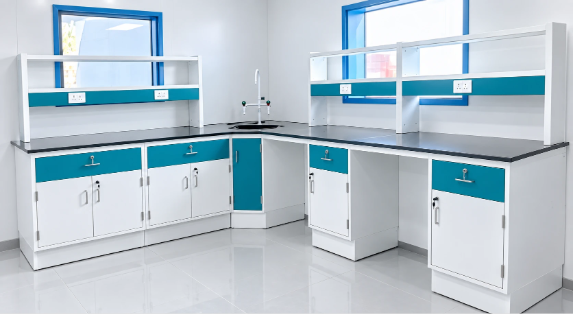
A large laboratory project may require several furniture categories, including workbenches, storage cabinets, wall cabinets, island benches, laboratory tables, sinks, and specialized workstations.
Working with a supplier that can provide multiple compatible furniture systems may simplify procurement and coordination.
However, a broad product catalogue alone does not guarantee that a supplier is suitable for your project. You should confirm that the available products meet your technical requirements.
When reviewing a supplier’s product range, consider whether it offers:
- Laboratory workbenches and workstations.
- Wall-mounted and freestanding storage cabinets.
- Chemical storage solutions appropriate for the substances involved.
- Laboratory tables and island benches.
- Suitable laboratory sinks and worktop systems.
- Modular laboratory furniture.
- Custom furniture designed for specific equipment or room layouts.
- Installation and related project support, where required.
Also, clarify whether the supplier manufactures the products, sources them from other manufacturers, or combines both approaches.
This information helps you understand who is responsible for product quality, customization, warranty support, and replacement components.
Practical tip: Ask the supplier to map its proposed products against your furniture schedule. This makes it easier to identify missing items, specification differences, and potential compatibility issues before placing the order.
5. Assess Customization and Laboratory Design Capabilities
Not every laboratory can use a standard furniture layout.
Equipment dimensions, utility connections, storage requirements, room geometry, and staff workflows can all influence the final design. In large-scale projects, these details need to be addressed before manufacturing and installation begin.
Evaluate whether laboratory furniture suppliers can accommodate the specific requirements of your facility.
For example, you may need workbenches designed around particular instruments, cabinets with non-standard dimensions, or modular furniture that can be reconfigured as your research requirements change.
Discuss the supplier’s approach to:
- Reviewing architectural drawings and floor plans.
- Preparing furniture layouts and technical drawings.
- Selecting materials based on laboratory activities.
- Coordinating furniture with electrical, plumbing, and other utility connections.
- Adjusting dimensions to suit the available space.
- Planning access for equipment installation and maintenance.
- Reviewing and approving drawings before production.
Ask who is responsible for verifying measurements and obtaining approval for the final layout.
These steps can help reduce the risk of furniture arriving in the wrong dimensions or interfering with equipment, doors, walkways, and utility connections.
For projects involving multiple laboratories, request clear documentation showing which furniture specifications apply to each room.
A supplier with suitable design and customization capabilities can help turn your project requirements into a practical furniture plan.
6. Compare Quotations Beyond the Initial Price
Budget is an important consideration in large-scale laboratory projects. However, choosing the lowest quotation without examining its contents can create problems later.
Two laboratory furniture suppliers may quote different prices because they are offering different materials, construction standards, accessories, warranties, or installation services.
To make a meaningful comparison, request itemized quotations based on the same specifications.
Your comparison should consider:
| Cost factor | What to evaluate |
|---|---|
| Furniture and materials | Product dimensions, materials, finishes, and construction quality |
| Customization | Design changes, non-standard dimensions, and specialized components |
| Transportation | Packaging, freight, delivery charges, and site access requirements |
| Installation | Assembly, positioning, fixing, and installation responsibilities |
| Additional components | Accessories, fittings, and other specified items |
| Warranty | Coverage, exclusions, and warranty duration |
| After-sales service | Repair support, replacement parts, and maintenance assistance |
| Payment terms | Deposits, milestone payments, and final payment conditions |
You should also clarify whether taxes, unloading, storage, and other project-related expenses are included.
For example, one supplier might offer a lower furniture price but charge separately for delivery and installation. Another might provide a more comprehensive quotation that includes these services.
The second option may offer better overall value, depending on the scope and quality of the work.
When comparing laboratory furniture suppliers, focus on the total project cost, specification compliance, and expected long-term performance, rather than the purchase price alone.
7. Verify Manufacturing Capacity and Delivery Timelines
Delays in furniture delivery can affect several stages of a laboratory project, including equipment installation, commissioning, staff training, and the planned opening date.
This makes manufacturing capacity and delivery planning particularly important when evaluating laboratory furniture suppliers.
Ask the supplier to explain how it will fulfil your order within the required timeframe.
Useful questions include:
- What is the estimated manufacturing lead time?
- Are the required materials and components readily available?
- Can the supplier handle the entire order or will deliveries need to be divided into phases?
- How will production progress be monitored?
- What happens if a component is delayed?
- Can the supplier coordinate deliveries with your construction schedule?
Request a written delivery schedule that identifies major milestones, including drawing approval, production, quality inspection, dispatch, delivery, and installation.
For very large projects, phased delivery may be more practical than receiving all furniture at once. However, the schedule should be coordinated with site readiness and installation requirements.
It is also useful to establish how schedule changes will be communicated and managed.
A realistic delivery plan is more valuable than an ambitious promise that the supplier cannot reliably meet.
8. Examine Quality Control and Documentation Procedures
Large-scale procurement requires confidence that the furniture delivered will match the approved specifications.
Even when a supplier offers good products, inconsistent manufacturing or inadequate inspection can result in dimensional differences, damaged finishes, missing components, or installation difficulties.
Ask laboratory furniture suppliers about their quality control procedures.
Find out whether they inspect raw materials, verify dimensions during production, check finished products, and review orders before dispatch.
Depending on the project, you may also request:
- Approved technical drawings.
- Product specifications and material information.
- Inspection reports.
- Relevant test reports or certifications.
- Installation instructions.
- Warranty documents.
- Maintenance guidelines.
- A final list of supplied products and components.
Where appropriate, arrange a sample review, product demonstration, or pre-dispatch inspection before approving the full order.
For large furniture packages, an agreed inspection and acceptance process can help both parties identify issues before the products reach the site.
Documentation is especially important when several laboratories have different technical requirements. It creates a clear record of what was specified, supplied, and accepted.
9. Evaluate Installation and Project Coordination Support
Supplying furniture is only one part of a large laboratory project. The furniture must also be delivered, assembled, positioned, and installed correctly.
Poor coordination during installation can cause unnecessary disruption, particularly when multiple rooms, contractors, and equipment suppliers are involved.
Before selecting a laboratory furniture supplier, confirm what installation services it provides and where its responsibilities end.
Discuss whether the supplier will:
- Review site readiness before delivery.
- Coordinate installation dates with your project team.
- Provide trained installation personnel.
- Assemble and position the furniture.
- Complete agreed fixing and alignment work.
- Coordinate with other contractors where required.
- Inspect the completed installation.
- Address defects or incomplete work before handover.
Clarify who is responsible for preparing utility connections and resolving site conditions that could affect installation.
For example, a laboratory workbench may need to be coordinated with plumbing, electrical services, or equipment positioning. These requirements should be addressed in the project plan rather than left until installation day.
A clear division of responsibilities helps avoid confusion and reduces the risk of costly rework.
10. Review Warranty Terms and After-Sales Support
Laboratory furniture is a long-term investment. Once the facility becomes operational, you may need replacement components, adjustments, repairs, or advice on maintenance.
For a large facility, the absence of reliable after-sales support can create operational difficulties.
When evaluating laboratory furniture suppliers, ask about warranty coverage and the process for reporting problems.
Pay attention to:
- Warranty duration for different product components.
- Coverage for manufacturing defects.
- Exclusions related to misuse, chemicals, or improper maintenance.
- Availability of replacement parts.
- Procedures for reporting damaged or defective products.
- Expected response times for service requests.
- Availability of technical assistance after installation.
Do not assume that every component has the same warranty or that installation-related issues are automatically covered.
Request written warranty terms and clarify how claims will be handled.
It is also worth asking whether the supplier provides maintenance recommendations and whether replacement components are likely to remain available over the expected service life of the furniture.
A supplier that offers clear support arrangements can help you manage the long-term ownership of your laboratory furniture more effectively.
11. Check Safety Requirements and Applicable Standards
Laboratory environments can involve chemicals, biological materials, heat, heavy instruments, and other potential hazards. Furniture must be suitable for the activities taking place in each workspace.
However, not every laboratory requires the same furniture materials or safety features.
The right selection depends on the intended application, the substances handled, the equipment used, and the relevant local regulations and project specifications.
Ask potential laboratory furniture suppliers how their proposed products address your facility’s requirements.
For example:
- Are the worktop materials suitable for the chemicals used in the laboratory?
- Can the workbenches support the expected loads?
- Are storage cabinets appropriate for their intended contents?
- Are exposed edges, fixings, and structural components suitable for the working environment?
- Can the supplier provide documentation supporting any claimed performance characteristics?
- Are additional safety features required by the project’s specifications?
Where applicable, confirm that specialized equipment, such as fume cupboards or chemical storage cabinets, meets the relevant requirements for its intended use.
Remember that laboratory furniture alone does not guarantee a safe laboratory. Appropriate ventilation, equipment selection, operating procedures, training, and maintenance are also essential.
The goal is to select furniture that supports the overall safety and functionality of the facility.
12. Assess Communication and Project Management
Large-scale laboratory projects often involve architects, consultants, procurement teams, contractors, laboratory managers, and equipment suppliers.
If communication is unclear, small issues can become major delays.
For this reason, evaluate the supplier’s project management approach before committing to an order.
Ask whether you will have a dedicated project coordinator and how often you will receive progress updates.
You should also understand how the supplier handles design revisions, specification changes, delivery adjustments, and unexpected problems.
A well-managed project should have:
- A clearly defined scope of work.
- A documented project schedule.
- Agreed technical specifications.
- A process for approving drawings and changes.
- Identified responsibilities for each party.
- Regular progress communication.
- A documented handover and acceptance process.
These arrangements are particularly useful when furniture is being installed across multiple buildings or in several project phases.
A supplier that communicates clearly and documents important decisions can make the procurement process easier to manage.
Common Mistakes to Avoid When Selecting Laboratory Furniture Suppliers
Even experienced procurement teams can overlook important details when working under time or budget pressure.
Here are some common mistakes to avoid:
Choosing a supplier based on price alone: A low quotation may exclude essential components, installation services, or suitable materials.
Ignoring technical specifications: Furniture that looks suitable may not withstand the chemicals, loads, or cleaning procedures involved in your laboratory.
Overlooking customization requirements: Standard furniture may not fit your room dimensions, equipment, or utility connections.
Failing to verify project experience: A supplier with limited experience in large orders may struggle with coordination, production, or delivery.
Accepting vague delivery commitments: Without a documented schedule, it becomes harder to manage dependencies and respond to delays.
Ignoring warranty and service conditions: Unclear support arrangements can increase the difficulty of resolving problems after installation.
Skipping drawing approvals: Manufacturing before the final layout and specifications are approved can lead to expensive corrections.
Failing to define installation responsibilities: Unclear responsibilities can result in disputes, incomplete work, and additional costs.
Avoiding these mistakes will help you compare laboratory furniture suppliers more effectively and make a more informed purchasing decision.
Checklist for Evaluating Laboratory Furniture Suppliers
Before making your final decision, use this checklist to assess each supplier consistently.
| Evaluation criteria | Questions to consider |
|---|---|
| Project experience | Has the supplier completed comparable large-scale projects? |
| Product quality | Are the materials and construction suitable for the intended application? |
| Product range | Can the supplier meet the project’s furniture requirements? |
| Customization | Can it accommodate approved layouts and technical specifications? |
| Pricing | Is the quotation itemized and based on comparable specifications? |
| Manufacturing capacity | Can the supplier fulfil the required quantities? |
| Delivery | Is there a realistic, documented delivery schedule? |
| Quality control | Are inspection procedures and relevant documents available? |
| Installation | Are installation responsibilities and site requirements clearly defined? |
| Safety | Do the proposed products meet the project’s applicable requirements? |
| Warranty | Are coverage, exclusions, and claim procedures documented? |
| After-sales support | Is technical assistance and replacement-part support available? |
| Communication | Is there a clear project management and escalation process? |
You can use this checklist to compare shortlisted suppliers and identify which one offers the best overall fit for your project.
Conclusion: Choose a Laboratory Furniture Supplier That Supports Your Project From Start to Finish
Selecting laboratory furniture for a large-scale project involves much more than comparing prices and product catalogues. It requires careful evaluation of material quality, technical suitability, customization capabilities, manufacturing capacity, delivery schedules, installation support, and after-sales service.
The right supplier should understand your facility’s requirements and provide a clear plan for delivering furniture that meets your specifications.
Take time to define your project scope, compare itemized quotations, review technical documentation, and verify the supplier’s ability to manage large orders. These steps can help reduce procurement risks, control costs, and support the long-term performance of your laboratory.
Ultimately, the best laboratory furniture supplier is not necessarily the one offering the lowest price. It is the one that can deliver the right products, maintain consistent quality, coordinate effectively with your project team, and provide dependable support when needed.
Looking for Reliable Laboratory Furniture Suppliers for Your Next Project?
Whether you are establishing a new research facility, upgrading an educational laboratory, or planning a large pharmaceutical or industrial laboratory, choosing the right furniture partner is essential.
Contact our team today to discuss your laboratory furniture requirements. We can help you explore suitable furniture options, review your project specifications, and identify solutions aligned with your facility’s layout, operational needs, and budget.
Request a quotation today and take the next step toward creating a functional, durable, and well-organized laboratory workspace.