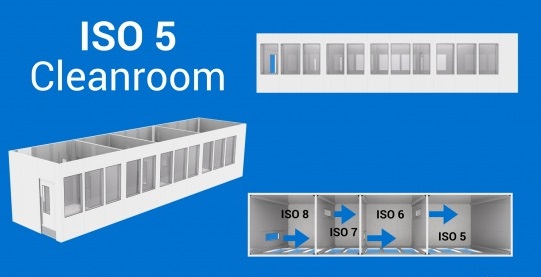
In theory, for a classified room (not just below a LAFW hood) to reach ISO class 5 air cleanliness, you need to enter the cleanroom via an ISO 8 (ante-room), then go through an ISO 7, followed by an ISO 6 to finally get into the ISO class 5 cleanroom.
In reality, however, you can reach an ISO 5 cleanroom with 2 or 3 airlocks. The optimal layout depends on the process taking place inside the cleanroom, the size of the room, the number of people working inside, the equipment inside, etc.
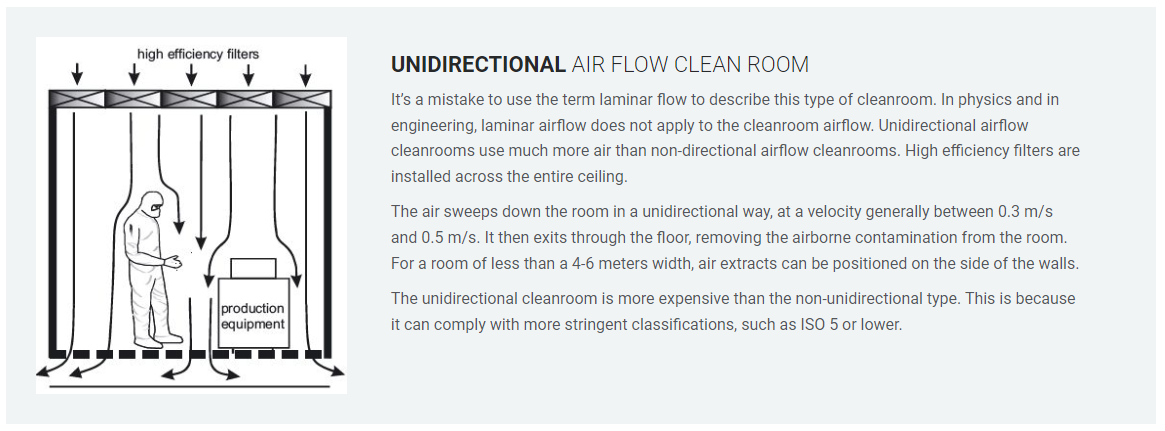
In addition, an ISO 5 or class 100 clean room needs to use unidirectional air flow. Unidirectional air flow cleanrooms use much more air than non-directional air flow cleanrooms. High efficiency filters are installed across the entire ceiling.
The filtered air sweeps down the room in a unidirectional way, at a velocity generally between 0.3 m/s and 0.5 m/s, and exits through the floor, removing the airborne contamination from the room. Cleanrooms using unidirectional air flow are more expensive than non-unidirectional ones, but can comply with more stringent classifications, such as ISO 5 or lower.
Some of our ISO 5 Cleanroom past projects :
ISO 5 Nanofabrication cleanroom facility
IT’S ALL ABOUT AIR FLOW PRINCIPLES