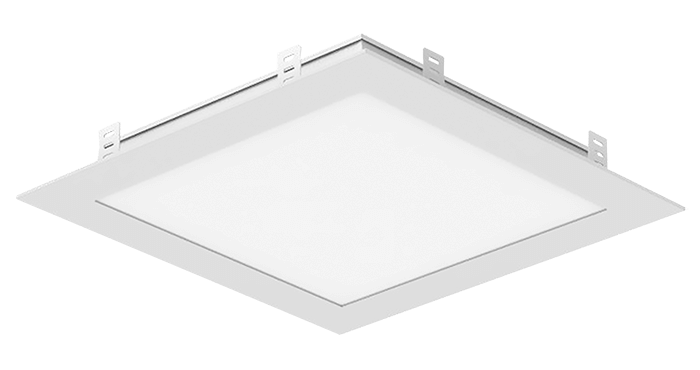
Lighting systems are designed to ensure visibility. In cleanrooms, ultraviolet (UV) light can also be utilized to disinfect the air. UV devices can be installed in ceiling light fixtures to irradiate the air, effectively killing potentially infectious particles, including up to 99.99% of airborne microbial and fungal contaminants. In the United States, the unit of lighting luminance is the foot-candle, which is equivalent to 1 lumen per square foot. Lumens measure the light output (luminous flux) of a source.
Requirement:
- Should be low electromagnetic interference from lighting fixtures.
- Mechanical/electrical rooms – 30 Foot candle (fc)
- As per Federal Standard (209E) Cleanroom – 100 fc or more
- Food inspection and grading cleanroom – at least 150 foot-candles
Cleanroom Lighting types
Fluorescent Lamps
The key characteristics to be considered in fluorescent lamps are the color temperature, color rendering index (CRI) and lumen output.
Color Temperature
Color temperature describes how occupants within the room will perceive the light source.
Color temperature is measured by Kelvin degrees, ranging from 9000K (which appears blue) down to 1500K (which appears orange red).
Typically, lamps are specified between 4000K, described as cool, and 3100K, which are described as warm.
Lamps with temperatures around 3500K are considered “neutral” and often specified in cleanrooms.
Color Rendering Index (CRI)
Color rendering describes the effect a light source has on the appearance of colored objects. The CRI scale ranges from 0 to 100 with most lamps available from 60 to 90 CRI. In general, with higher CRIs, the color appearance of objects will be more accurate within the room. Lamps with CRIs of 85 are commonly specified for cleanrooms.
Lumen Output
Lumen ratings can vary depending on the lamps used. Specifying lamps with higher initial lumens will reduce the number of fixtures required to achieve a desired foot-candle level. However, the number of light fixtures and their spacing should be reviewed to produce a uniform lighting level throughout the space.
Ultraviolet (UV) Spectrum
Fluorescent lamps produce some energy in the ultraviolet (UV) spectrum, which can be detrimental to certain cleanroom processes. UV filtering can be accomplished with lens shielding or tubes to cover the lamps. However, this shielding converts the visible light to yellow color, which is not as pleasing to the occupant. While the shielding may reduce illumination levels by only 10 to 20 percent, the perceived lighting levels can seem less due to the color shift.
Features
Energy Efficiency
Low Maintenance
Long Life
UV Light
UV light is used to reduce bacteria or other biological contaminants.
Designed with contamination control issues—electromagnetic field generation and cleanability—in mind.